There is no any kind of doubts Dark Maze's online series NINJA THE MISSION FORCE has become into a milestone of "ninja entertainment". No one could ever imagine the work of Ed Glaser & Meagan Rachelle could catch the Godfrey Ho style in a very pure way they have done!...but not only they offer us what an IFD or Filmark movie offered us 25 years ago but they also add a devilish funny sense of humour that was also included ( in a different way & not purposely wanted) on those movies that inspire this humble blog.
This week, Ed Glaser offers us a very delicious dish, a special bracket in the regular series. This week, we can enjoy a superb interview to Andy Chworovsky, one of the men who made possible that sense of humour worked in some IFD movies. Mr Chworovsky kindly granted a very nice & funny interview where he reveals a lot of "secrets" of his ninja movies, his work as dubber in Hong Kong & other experiences at Hong Kong cinema industry.
A great present from Dark Maze to all the fans. Don't waste your time & enjoy the interview on NINJA THE MISSION FORCE official site clicking
here or just continue reading this post....but don't forget, Dark Maze offers this interview on audio track on its web.
 |
| Andy Chworovsky takes the show in Ninja the Protector. |
INTERVIEW TO ANDY CHWOROVSKY by Ed Glaser
Ed Glaser: Hello, I’m Ed Glaser of Dark Maze Studios and the director/producer of “Ninja the Mission Force”.
Meagan Rachelle: And I’m Meagan Rachelle, writer of “Ninja the Mission Force”.
EG: As long time fans of the Godfrey Ho cut and paste ninja movies,
we’ve both always wondered what it was like to be a part of the crazy,
colorful ninja world of IFD films. And as luck would have it, we’re
here today with Andy Chworowsky, who was an actor and a dubber of these
unique films. You might know Andy as the cop in “Ninja the Protector”
who famously asks “what’s a ninja?”
MR: And it’s a role he was kind enough to reprise in our Godfrey Ho-mage parody series, Ninja the Mission Force
G: Andy, thanks so much for sitting down virtually with us!
Andy Chworowsky: Oh, my pleasure!
EG: So, where are you from originally?
AC: Milwaukee, Wisconsin.
EG: Really?
AC: That’s were most of the big stars in Hong Kong came from. At least one.
MR: The only one we care about
AC: Exactly. Or know about.
EG: So what brought you to Hong Kong?
AC: I was ten years old when we moved here. My dad was – well he still is – a preacher. A missionary, he came out here to “convert the masses.” It was about 1973. So my folks lived here for about eight years and by the time I finished high school I was already dubbing movies, and to my inexperienced mind the money was fantastic. So I said “why don’t you go back to the States, I’ll stay here.” And I did.
EG: So how did you get into the dubbing business?
AC: I don’t even remember. A friend in high school met some guy that was doing it… there used to be a lot of it here because of – well, because it was cheap to do it here. Movies like this didn’t warrant being sent to a proper dubbing studio in Rome or Hollywood. So there were a bunch of teams and there was an awful lot of this content that was being pumped out of Hong Kong. Some of it went to the States, most of it went to Africa and Indonesia. Places that couldn’t really afford real movies. So there was probably 5-6 different teams of English language dubbers and you’d hop from one to another and it was honestly pretty good money. A day of work would be 150-200 dollars depending on how generous they were, and that was thirty years ago. So it wasn’t bad for a teenager’s job.
EG: I know they used to troll through Chungking Mansions looking for any Caucasians and asking ‘hey, you want to dub a movie?’
AC: Oh yeah. Pretty much the only stipulation was you had to have a facile enough mind to be able to read the script and watch the loop at the same time. The loops weren’t set up in any sort of reasonable fashion, they would just cut the movie into a one minute or two minute or three minute loop, stick all the characters in front of the microphone with a script and you had to keep one eye on the characters lips and one eye on the script and just bang it out. So acting was not their prime motive, it was just getting the lines out, almost syncing to the lip movements and that was about it.
EG: So it wasn’t like modern looping where there’s basically one line that loops over and over again until you nail it?
AC: Nope! And in fact it still isn’t. There’s a friend of mine who still does it for pretty big names here, some of the larger studio movies that are made out here and they still don’t do it that way! Of course it’s a lot easier now because it’s all recorded digitally so they can hop in and hop out in the middle of a phrase. But they still don’t edit the film out phrase by phrase and let you do it properly. So even now a 90 minute feature film will be dubbed in, two days maybe?
MR: I love the idea of it being done like radio drama, just one take – go!
AC: It really is. It really was. You’d get some of the dubbing guys who thought they would revolutionize it and say to everybody “okay everybody, we’re all standing up now! No sitting down, I want better performances.” That would last for about an hour, then everybody would pull the bar stools over and say “fuck off.”
MR: Was there anything that made IFD different to work for than any of the other companies, or were they all pretty much the same?
AC: They were all pretty schlocky. You know, who knows what was going on. It was such a commodity. People learned that you could make a suitcase full of these lousy movies and they could go to a film festival- really, they could go to Cannes, rent a hotel room and somebody would buy it. And they had – their budgets were minuscule, and if they could sell it for the cost of their budget plus their holiday in Cannes they figured, hey why not? And they do that a couple of times, they say to each other “let’s just keep making these things. And so they did.
EG: Hey, who wouldn’t?
AC: Yeah. There’s always been talk about the movie industry, that it’s ruled by triads and stuff, and there’s probably a lot of that that’s true, but it these guys were mobbed up they were mobbed up with the baby triads. You know? I don’t think there was any Mr. Big behind these things.
EG: So when did they ask to put you in front of the camera?
AC: Oh, you know we would dub for Godfrey and he would say “I’m making a movie next week, can you work on Tuesday?” And you’d say sure, and that was about all you were given. You’d show up in whatever clothes you were wearing that day and “okay- you’re a policeman,” “oh, okay” (laughs). It wasn’t one of Godfrey Ho’s, rather it was a bigger production starring a guy called Chan Wai-Man that I was in quite a lot and I must have been all of twenty years old, twenty one years old and looking as baby faced as I did in the Godfrey Ho productions and I go in and he says “okay, you’re a mafia guy!” And I said “I look about as much a mafia guy as you do.” And he said “doesn’t matter, doesn’t matter, just stand there and get hit.”
EG: Yeah! That’s “City Ninja”, which is also known as “Ninja Holocaust” or my favorite title, “Rocky’s Love Affairs”, because it’s about a boxer and I guess someone figured “let’s use the Rocky name” to try and cash in.
 |
| Chan Wai Man offered Mr Chworovsky his kicks on Ninja Holocaust ( aka City ninja, aka 108 golden killers) |
AC: If that is the same one and gosh, I appreciate your research, that one got really popular in Hong Kong because there’s a sex scene with what’s her name, Mona something or other, and I think she was an actress a little bit, a little past her sell by date? But I think the local population around here were very interested in seeing her get her kit off in a sex scene. So yeah, that one got me stopped in the street quite a few times.
EG: That’s great! And there was no real research, we came across the film and watched it and me and Meagan immediately both said “hey, it’s the guy from ‘Ninja the Protector’!”
AC: Oh wow, bless you. You have encyclopedic, or photographic minds I guess. Well I remember the first time I got kicked in the face by Chan Wai-Man . Everything’s going on in Chinese, I have no idea what’s going on, and I’m placed in front of a pile of boxes, he comes up and lifts his toe, his leg is totally straight, lifts his toe like a ballerina up to my nose, tickles the edge of my nose with his toe, and the only English I heard that day was “DON’T. MOVE.”
EG: Oh my goodness!
AC: And he swings around in a full roundhouse kick and his toe just brushes the edge of my nose. So the guy knew what he was doing. I flew back into the boxes and they all thought it was just fantastic.
EG: Oh, but that must be terrifying…
AC: Well yeah, because I’m sure they had nothing like insurance or anything like that.
MR: Or bandages…
AC: Yeah!
EG: I know the IFD films were usually created by filming scenes of Caucasian actors and splicing them into unrelated films to which IFD already owned the rights. How much did you know about how your scenes were going to be used? It sounds like maybe not a lot from what you’ve already mentioned.
AC: Right, almost not at all. In fact, as you may have guessed, there was only the suggestion of a script when you’d get on set. The script… for one thing, it would be written in twice translated English. So we would be sitting there looking at it saying “what the hell does this mean?” for one thing. And then Godfrey would sort of explain the plot, in his kind of hyper, babbling way, and then we’d sort of make it up on the spot and try to figure out for him what he wanted. Then they’d splice it together and really the only time I’d see what he was going for was when I’d see the thing in the dubbing studio when we’d come back a month later when it was edited. But even then, as you know, they really really don’t… make… sense. There’s the merest suggestion of a hint of a plot somewhere in there. But no, it was very much making it up as we went along. And I mean, we really tried to figure out what he was going for, and give him something to work with, but it wasn’t so easy. And poor old Richard Harrison, I mean he was a very nice fella, and I think he was living in Rome at the time or something, and he would tell stories of times when I guess he would get better parts than this. But he certainly seemed like all the dreams had died by then.
EG: He has been pretty vocal about not being particularly thrilled about the Godfrey Ho period in his career.
AC: Yeah. As far as I know Godfrey brought him out here twice, maybe more than that. But I think he never knew that these scenes were going to be cut into a dozen different movies. So I think there was probably a little subterfuge there.
 |
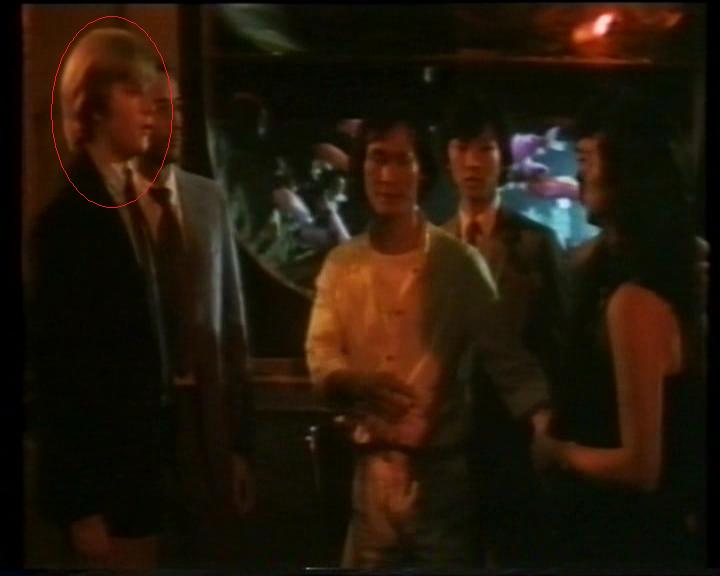
| Andy Chworovsky shared the screen with other IFD regulars like John Ladalsky (far left) or Martin Lee ( right) who also worked starred Ninja Dragon or Diamond Ninja Force. |
MR: Speaking of Godfrey Ho, what was he like as a director on set then?
AC: Well, sort of being directed by like, the accountant, of the company. I mean he so didn’t know what he was doing. I guess the closest equivalent would be if you got a bunch of – well, this is kind of an insult to ten year-olds – but if a bunch of eight or ten year-olds got a hold of grandpa’s super 8 movie and went “okay, okay let’s do this, let’s do this nonono wait, and you do this, and I’m this, and okay you stand there,” it was very much that. You’ll notice he had a real predilection for some symmetry. If anyone ever met they would stand in a perfect circle, spaced out.
EG: Oh, yes.
AC: You know, these are just sort of random impressions, honestly I don’t know (laughs) I don’t know when and how he ever thought he could make movies but he just went out there and did it. So I guess more power to him for that. I mean I wouldn’t have that self confidence.
EG: Would he sort of collaborate with the cinematographer or anyone else? Because I know there’s a lot of camera motion in his films, there’s a lot of really complicated action, even if the fights are kind of silly there’s a whole lot going on in them.
AC: Yeah, I think, well I think you’re right, the camera man would have been one of the old pros, would have worked for the Shaw Brothers or Golden Harvest or something. So in that respect yeah, the camera men would probably know the moves and the guys who went in the ninja suits for the fight scenes, they obviously weren’t the westerners, they were the guys who actually knew how to fight, the Chinese guys. You know, they knew what they were doing, as far as the fighting goes. They had to, otherwise they would have hurt themselves. So I think the one thing the cameramen – cinematographer’s a stretch – knew was how to put together a fight sequence. So in that respect I’m sure Godfrey just handed it over to the stunt doubles and the camera men and let them get on with it.
MR: He sort of sounds like a Hong Kong Ed Wood, where he hired competent people but he himself is not necessarily in charge of them doing things right.
AC: Yeah, I would say so, I think probably without the charm or the enthusiasm of Ed Wood. But certainly with the self confidence, with the “okay, it’s okay, no problem no problem that’s fine, good good good good move on move on” you know.
EG: Oh, that’s great.
AC: You know I never saw him sitting at a Steenbeck editing, and I don’t know who the editor was, must have been an awful big job to put these things together in any sort of cogent fashion.
EG: I would imagine. Speaking of cameras and equipment, how much equipment would these productions have? Would they have lights and reflectors and so on, or was it very mini-
AC: Very minimal. Very little. You know, there’d be one Arriflex camera, there’d probably be a couple of lights and a lot of styrofoam sheets reflecting whatever other light was in the room or outside. I mean the whole crew, we’d film an exterior shot and I think the whole crew, including director, would maybe be four or five people.
EG: You get that impression.
AC: But most of those were just there to carry stuff, and as you say hold light reflectors.
MR: So as you were working on these, what were your thoughts about them at the time?
AC: Oh, it was just a lark you know. He also didn’t pay anything. Being on screen paid less than dubbing. If I recall correctly it was probably seventy-five bucks for the day. And plus if you got in any action scene you probably ruined your clothes too. It really was just play acting I certainly never thought “hey, this is the start of something big.”
EG: (laughs) Your big break!
AC: Yeah. I fear some of the people in those films, some of the as you mentioned world travelers might have thought “hey! Hey I’m gonna break into the movie business!” But I think most of us recognized it for what it was.
MR: I think that’s one of the reasons, you know, we recognized you when you popped up in another movie – you can tell the people who were having fun, and that energy really comes through and that’s part of the charm for a lot of us watching these now. “Oh yeah that guy looks like he was having fun that day” – that’s always great to see.
AC: I remember in that other movie you mentioned, there’s a scene where we kidnap some guy and I drive him up in a Mercedes. And I had no drivers license at that point.
EG: And you were the driver!
AC: Oh yeah. And we drove up one of the windiest roads on Victoria Peak over here filming this and I look back on that and think “boy, I could have killed everybody there.”
 |
Nice people always play the best bad guys in cinema. Andy Chworovsky is a good example of it! |
EG: Oh that’s great! Well, we talked a little bit before about Richard Harrison. You worked with him on both “Ninja the Protector” and “Diamond Ninja Force”, which is the one where you played a bad guy. What was it like working with him, what kind of a guy was he? What was his attitude on the set? I know he’s since spoken out against the films, was he fairly positive on the set?
AC: I think he was…I would probably describe it as stoic. I think he was enough of a professional to say “I’m here, I’m getting paid, I’ve just gotta get through this.” Bless his heart, I don’t think he ever argued or shouted or anything like that. I mean, you look at the ridiculous costumes they put him in – the white headband with “ninja” printed on it was my favorite, because you wouldn’t be able to tell it was a ninja without a label across it right?
EG: Of course not!
MR: And the picture of a ninja between the word ninja.
AC: Exactly. And the ridiculous eye makeup. I think he just sort of sighed and got through it. He was a very soft spoken, very pleasant fellow when you’re waiting on the sidelines. And gosh, he was awfully handsome too. He really had movie star looks. I can’t really comment on his acting ability because I don’t think his voice was ever his own in the final product. These were all shot silent. Oh that’s another name, John Culkin almost always dubbed his voice, John Culkin still works here, also for radio Hong Kong. He’s a DJ on RTHK still. But so, it’s hard to tell. I think Richard was a decent, nice fellow who needed the work.
MR: So, what were you doing with yourself when you weren’t on set?
AC: Well, the dubbing was fairly full time for awhile when I finally got enough of it. It’s fairly soul destroying work. You realize “I’m involved in nothing that benefits mankind at this moment.” But I think, when was it, about ’87 I think, I finally packed it in and I went back to the States for a year, came back here and was hired by a new restaurant company, and that’s when I sort of switched into a different line of work. Worked for them for a while, and then went back to the States again, went to college – I went to hotel school. Finished that, then I came back to Hong Kong finally in ’96 and started my own company in ’98 – a restaurant company called Fat Angelo’s, and that’s what I’m doing now.
MR: So what kept bringing you back to Hong Kong, what was the main appeal for you?
AC: Well, I moved here when I was ten. I think it just got under my skin. Like I said I spent time back in the States, and the lifestyle here is a little more, I dunno, a little more fun than anywhere I was in the States. I actually lived near LA for a year and, I don’t know where you guys are located, I think LA would be a nice place to live if money was no object. That year money was quite an object and I really didn’t enjoy it at all.
MR: We’re actually based in Illinois, so when you said you were from Wisconsin we sort of gave each other a knowing nod and went “Ah, I understand Hong Kong more now!”
AC: Excellent, excellent. Yeah. I moved here when I was ten and it just became normative for me. This really was my home town and every time I lived in the States I really felt like I was in a foreign country. I always finagled a way to get back here.
EG: So it seems like there really was a hodgepodge of people with very different backgrounds involved in these IFD films. What was it like, what were the rest of the cast and crew of these films like?
AC: As you say, from everywhere. You know, back then Brits could come here without a visa so you had a lot of kids from England and at that time the economy in England was pretty crappy, so a lot of people were sort of economic migrants coming here to give it a try, and a lot of people would fall into English teaching, fall into dubbing – that isn’t to say that they didn’t have other talents, but there were a lot of people I knew who got picked up to do these bits and bobs dubbing or acting and then went on to do other things, some more successfully than others. So I’d say most of the people on our teams were English, or Brits, on the dubbing teams and on the film teams as you rightly pointed out they would troll through Chungking Mansions, puts ads up on bulletin boards in travelers hostels. You know, “be in a movie, call this number” sort of things. So you had people from everywhere. And of course, accents didn’t matter because it was all dubbed in later. And you know, he [Godfrey Ho] wouldn’t even record guide tracks or anything. So when it came to writing the dubbing script, whoever was the lucky bastard who got to do that, he had to make it up as well, because you often couldn’t tell what they were saying because the script wasn’t that accurate as well.
 |
| Andy on the set of Diamond Ninja Force |
EG: So you were just winging it – somebody was just winging it!
AC: Oh yeah, oh yeah.
MR: Were they any – with that many, especially Brits, and locals working on these, I know language must have been a barrier, but were there any culture or personality clashes with that many different types?
AC: I’m sure there were. I don’t think it was a big problem, and Godfrey Ho spoke English in a fashion, I would say probably none of the other crew would speak English. You know if you had a scene with a local person, you would just deliver your lines in English and he would deliver his lines in Chinese, and it just didn’t matter. You knew sort of what he was saying, and you were told “say this line – no, say it louder and then, you know, fight.”
EG: The ninja version of a spaghetti western.
AC: Very much so. Yeah you know the old Trinity movies it was only the stars that were speaking English, even Terence Hill and Bud Spencer spoke it with an Italian accent. You know, I don’t think anyone was under any illusion that what we were doing was any good, so you just went with the flow, and did what you were told, and if it weren’t for YouTube we would have all forgotten about them.
EG: Well YouTube and those giant 50 movie pack collections that come out from Mill Creek and those other companies.
AC: Yeah but the distribution of those is probably not quite as wide as YouTube.
EG: No, that’s true.
AC: It’s a fairly niche market of people who pore through those things I think.
EG: Yeah, I guess that’s fair. So, we talked a little bit earlier about the film “City Ninja” which has a bunch of other titles, but that was one you did before IFD?
AC: I don’t know! Oh, the one where I was the mafia guy?
EG: That’s the one.
AC: Yeah yeah yeah, honestly I’m not sure where that falls in the chronology of my life. I know it was in there amongst that, it was probably earlier but I don’t quite recall.
EG: Was that one different from working with IFD?
AC: It was a little bit bigger budget, yeah. They had nightclub scenes with 60 or 70 extras, they had cars and explosions and the star in that Chan Wai-Man was quite well known. He was sort of a second tier star but he was well known in Hong Kong. He was known as sort of a bad boy, I think he went to jail two years later. It was a weapons possession charge or something like that. There’s strict gun control here. Anyway, so that one was a little closer to what real professional movie making would be like. It wasn’t, I guess, totally horrible, and it kind of had a plot and all that stuff.
EG: Imagine that!
AC: I know, I know, amazing.
MR: It had one of the more disturbing film sex scenes we’ve scene in awhile, actually.
EG: Oh yeah, it was the one where they have sex on the exercise equipment.
AC: Oh yeah! I think I did look at that months ago.
MR: It’s memorable, I’ll give it that.
MR: So what are your best and worst memories of those IFD days?
AC: Well, filming outside during the spring and summer in Hong Kong was very hot, very sweaty, if you look closely my arm pits are almost always wet and stinky. I don’t want to slander Godfrey Ho, but Richard Harrison was telling me about one time when he was here and one of the plot points was that he had a little dog and then the bad guys killed the dog. Well, Harrison told us that Godfrey Ho actually killed the dog.
EG: Yeah, I’ve heard that story.
AC: It was in the course of making the movie, and then the dog’s carcass had to be kept in the fridge a week while they re-used it for various shots.
EG: Things no filmmaker would get away with in America.
AC: Well, god forbid they get away with it anywhere.
EG: Yeah, true, true enough.
AC: So that kind of sunk my opinion of Godfrey. But there’s perhaps a big cultural difference, or a big difference between now and twenty five years ago in people’s mindsets. But that was pretty disturbing. Allegedly. He allegedly did that. I didn’t’ see it with my own eyes.
MR: We’ll put the whole thing in quotes. Even though it’s only audio…I’m making air quotes, internet people.
AC: Come and get me, bring it on Godfrey.
MR: Any particular good memories? I mean we all sort of imagine it’s a bunch of Americans and Brits in their twenties in Hong Kong, so people imagine all kinds of things, but any great memories on or off the set in those days?
AC: I think even though these movies are just horrible, most of us knew it while we were doing it, so you’d stand off screen and just laugh. So it’s sort of like our own “Mystery Science Theater 3000” while they’re making the movie. So you’d stand off camera and go “oh my god, look what they’re doing there” so I do recall an awful lot of falling about laughing both on set and in the dubbing studio. I wish I had a specific instance for you, but I think the main point is we knew, I mean everyone knew this was crap, and this wasn’t really how mainstream movies were made.
EG: What do you think of these movies now, and specifically what do you think of the cult following they seem to have gathered?
AC: Well, I mean I’m certainly not surprised. I was a huge fan of “Mystery Science Theater” from it’s inception, the first time I sort of wandered into it on some channel when I was back in the States for a vacation or something, and I think as fodder – I would assume that the cult following is mostly from an ironic standpoint – I guess there might be a smaller niche that really do analyze the films and analyze the fight moves and all that but most people just watch them because they’re such clangingly bad scenes and you can take the piss out of them with a bunch of your friends with a case a beer. So I think it’s funny that way. I’m sure that you’ve seen the film, what is it the “Worst Best Movie” or the “Best Worst Movie”?
EG: Oh right, the documentary on “Troll 2”.
AC: Right, about “Troll 2”, which is just hilarious. So I mean, god bless all these horrible– god bless Godfrey Ho for bringing so much joy to people’s lives, even though that wasn’t his intention. Or wasn’t his intention quite that way.
MR: We sort of made joyful faces when you mentioned “Mystery Science Theater 3000”. Everyone who’s ever done anything with Dark Maze is a huge fan and we do get together and watch these. We do watch a lot of bad movies and sort of just take pot shots at them but we really love these because they’re ridiculous but there’s so much energy and joy and sheer madness.
AC: And they’re so earnest.
MR: That and Turkish movies. They’re so earnest and they’re just going for it and there’s robots sometimes for no reason and you just have to love that about them.
AC: A lot of those moments where you just go “wait…what?”
MR: Yeah. “How did- who did- what? Why? Who decided he has a Garfield phone? My god we need a Garfield phone.”
 |
| Andy Chworovsky also played a caucasian killer in Frankie Chan's Burning Ambition |
AC: Right, the Garfield phone…
MR: Ed actually did after watching that hunt down a Garfield phone just to have.
EG: Yeah I did.
AC: No kidding?
EG: Yeah, Richard Harrison has that Garfield phone in a couple of movies, including “Diamond Ninja Force” which you’re in, and I thought “oh, I hafta get one of these now” and I thought “I’ve got to do some sort of Godfrey Ho parody in the future. I don’t know what it’s going to be yet but I’m going to get this phone, I’m going to track it down on eBay” and I did.
AC: Fantastic.
MR: So, this series is based on the fact that Ed has this phone, based on the fact that that phone was in that scene.
AC: You just need a kernel, that’s it, a kernel, it only takes a spark to get a fire going.
MR: A tiny seed of madness.
AC: I was just thinking, what was it, back in the mid 80′s, Garfield was huge then right?
MR: Oh yeah.
AC: So they probably thought, “ooh, we we need something sophisticated that Westerners will identify with. I know! Garfield!”
MR: It always reminds me, I actually had a phone from Singapore that was an exactly modeled on McDonalds french fries and I think it was the same thing of “the West, in electronic form!” Here’s a french fry phone – what?
AC: Here’s something you can identify with.
EG: It’s the most wonderfully goofy thing because here you’ve got Richard Harrison, star of spy movies and spaghetti westerns, and all kinds of films, looking very dignified and handsome, the phone rings, you don’t see it, he goes to sit down and close up on a Garfield phone and your brain just explodes.
AC: You couldn’t have thought that up if you were writing a spoof.
MR: That’s actually the hard thing with writing “Ninja the Mission Force”. No line I could come up with, no line, no situation is ever as absurd or out of left field as what actually happened in these movies.
AC: It’s really a hell of a challenge.
MR: They’re really hard to spoof because it’s already seven layers over the top so we sort of just did the same thing.
AC: God it must be fun.
MR: Oh yeah.
AC: I suppose you must just have a cornucopia of material to work with, it’s just must take ages to go through it all.
MR: Sort of an embarrassment of wackiness. We sort of embody it all in the slogan for this series, which is “Never Explain, Never Apologize.” As long as it doesn’t make sense at the end of the day, we’ve done our job.
AC: Well that certainly could have been Godfrey Ho’s motto as well. I’m sure it was, it probably just got mis-translated. In fact – god I just remembered. One of the things I used to do in the dubbing studio because it was just ages and ages of sitting around doing nothing while other people were doing their bit, was I taught myself how to knit. Because it was too dark to read.
MR: I think I just fell in love with you a little bit.
AC: So I taught myself how to knit, and one of the things, one of the third or fourth things I ever made was Godfrey Ho had a baby, and I knit little footy trousers for the baby.
EG: Oh my gosh, that’s wonderful.
AC: He was very appreciative.
EG: They didn’t say “Ninja” on them, did they?
AC: No…
EG: Aw, that’s a shame.
AC: They were just dark blue yarn.
MR: Ninja baby…
AC: Ninja baby footy trousers. There you go, there’s your next movie!
EG: I love it!
MR: Ninja baby footie trousers.
EG: Green light!
MR: It’s the sequel to “Ninja the Mission Force”.
EG: Well, it’s just been a joy to have someone who lived that whole thing – we’ve both been dying to know what it was actually like to be involved in these crazy films in the ‘80s in Hong Kong and it’s just been terrific to talk to you and get the real scoop.
AC: It’s been my pleasure. It’s not too often that anyone brings it up. It’s fun to reminisce. It certainly was – when I run into people who used to dub and stuff that’s the thing, you just get into these laughing jags, you’d get into these 5-10 minute laughing jags where you just absolutely couldn’t breathe, just absolutely cramping up from laughing so much, and that would happen on a sort of bi-weekly basis. There was a lot of joy involved in it.
 |
| Sadly Andy Chworosvky just played a small cameo in Burning Ambition. |
MR: Well I have to say, we’ve gotten more joy out of watching your performances than a lot of Hollywood actors I could name, and I really mean that. We do occasionally, we didn’t know your name at first so you were “‘what’s a ninja’ guy” and all of our friends knew what we meant.
AC: All that dialogue was made up! We got the script and it was a bunch of garbage, and he got across to us that we were supposed to be skeptical so I might even credit myself with writing that line. I don’t recall exactly.
MR: It’s one of the most memorable lines ever.
EG: Absolutely, that’s one of the things that makes it stand out. The whole idea of Richard Harrison in the goofy camo ninja suit, coming back and telling you guys to go catch the guy, and the villain is always like “only a ninja can defeat a ninja” and you’re like “what’s a ninja?”
AC: Yeah. Well, now I’m very eager for you to finish your project.
EG: Absolutely, and I will be keeping you posted. It comes out, we’re premiering the first episode on February 15th, and do it weekly for the full ten episodes. It’s gonna be a blast, we’re really excited about it.
AC: Great, and I pre-approve any releases you need.
EG: Well thank you so much! Well Andy, thank you so much for sitting down with us and sharing your experiences, this has just been a complete blast.
AC: No problem.
EG: That was Andy Chworowsky, and you’ll be able to hear Andy again in the English dub of the upcoming Hong Kong action film “Naked Soldier”, where he voices kung fu superstar Sammo Hung. “Ninja the Mission Force” can be seen online at
Ninja The Mission Force.